VisasGreen Card
Trending

EB2 NIW Processing Time in 2026: Complete Timeline From I-140 to Green Card

Table of Contents

How long does the EB2 NIW process take in 2026?

For most applicants, the full timeline ranges between 2.5 to 3+ years from the moment they begin preparing their petition to the day they receive their green card. The total duration depends on several variables, including I-140 processing time, visa bulletin movement, country of birth, and whether the final step is completed through adjustment of status in the United States or consular processing abroad.

Processing times have shifted significantly over the past few years. What used to take under two years in some cases now often extends beyond that due to backlogs in both USCIS adjudications and employment-based visa quotas.

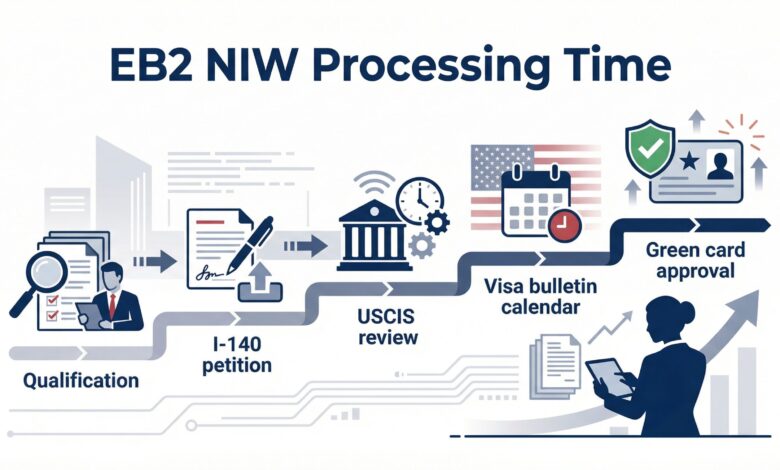
Understanding the EB2 NIW timeline requires breaking the process into clear stages:

  • Qualification assessment
  • I-140 petition preparation
  • I-140 adjudication
  • Visa bulletin wait (priority date backlog)
  • Final step: adjustment of status or consular processing

Each stage has its own timeframe, and some steps overlap while others must occur sequentially.

Before estimating your personal timeline, it is essential to understand how these stages interact.

Overview of the EB2 NIW Process – Step by Step

The EB2 National Interest Waiver process follows a defined structure. While timelines fluctuate, the sequence itself remains consistent.

Understanding the order of events helps clarify why the overall EB2 NIW processing time in 2026 often extends to several years.

Here is how the process unfolds.


1. Qualification Assessment

Before filing anything, you must determine whether you qualify under the EB2 category and meet the National Interest Waiver criteria.

This means demonstrating:

  • An advanced degree or exceptional ability
  • That your proposed endeavor has substantial merit and national importance
  • That you are well positioned to advance that endeavor
  • That waiving the job offer and labor certification requirement benefits the United States

This initial evaluation may take days or weeks depending on how thoroughly you assess your profile.


2. Preparing the I-140 Petition

Once you confirm eligibility, you prepare Form I-140 along with a comprehensive petition package.

This stage includes:

  • Drafting your proposed endeavor
  • Gathering supporting evidence
  • Obtaining recommendation letters
  • Preparing a detailed professional or business plan (if applicable)
  • Writing the petition cover letter

Preparation time varies significantly. For do-it-yourself applicants, this stage typically takes between one and six months depending on availability, documentation readiness, and professional obligations.

This is often the most labor-intensive part of the entire EB2 NIW timeline.


3. Filing the I-140 and Establishing the Priority Date

Once USCIS receives your I-140, your priority date is established.

This date determines your place in line under the employment-based visa quota system. The United States issues a limited number of employment-based green cards annually, and each country of birth is subject to allocation limits.

The priority date becomes central to your timeline moving forward.


4. I-140 Adjudication by USCIS

After submission, USCIS reviews the petition.

The officer may:

Standard processing currently extends well beyond one year in many cases. Premium processing is available and can significantly reduce this specific stage to a defined timeframe.

However, approval of the I-140 does not automatically mean you can receive a green card immediately. The visa bulletin must allow you to move forward.


5. Visa Bulletin Waiting Period

Because EB2 is quota-based, you must wait until your priority date becomes current under the Department of State’s monthly visa bulletin.

This backlog is often one of the longest phases in the EB2 NIW processing time in 2026, particularly for applicants born in countries with higher demand.

This stage cannot be expedited.


6. Final Step: Adjustment of Status or Consular Processing

Once your priority date is current, you complete the final stage:

  • Adjustment of Status (Form I-485) if you are inside the United States
  • Consular Processing (DS-260) if you are abroad

This final step includes background checks, biometrics, and in some cases, interviews.

After approval, you receive permanent resident status.


When looking at the EB2 NIW timeline in 2026, the key takeaway is that the total duration is the sum of multiple independent stages, some of which overlap and others that must wait for quota availability.


Step 1 – Qualifying for EB2 NIW (How Long Does It Take?)

Before thinking about processing times, forms, or premium options, the first question is simple:

Do you qualify for EB2 NIW?

This initial phase is often overlooked in timeline discussions, yet it sets the foundation for everything that follows.

How long does the qualification stage take?

For most applicants, this stage can take anywhere from a few days to several weeks, depending on how familiar they are with the EB2 NIW criteria and how complex their professional background is.

The timeline depends on:

  • How quickly you study the category requirements
  • Whether you consult an immigration attorney
  • How clear your professional achievements are
  • Whether your field aligns with national interest considerations

This stage does not involve USCIS. It is purely preparation and evaluation.


Understanding the EB2 criteria

To qualify under EB2 NIW in 2026, you must first meet the base EB2 requirements:

You must either demonstrate:

  • An advanced degree (master’s or higher, or bachelor’s plus five years of progressive experience),
    or
  • Exceptional ability in your field.

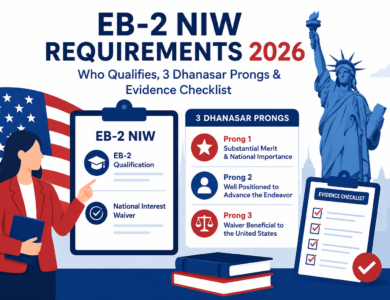
Then comes the National Interest Waiver layer, based on the Matter of Dhanasar framework.

You must show:

  1. Your proposed endeavor has substantial merit and national importance
  2. You are well positioned to advance that endeavor
  3. On balance, it benefits the United States to waive the labor certification requirement

Understanding and honestly assessing these three prongs is essential before moving forward.


Self-assessment vs professional evaluation

Some applicants conduct their own research and decide independently whether they qualify. Others prefer obtaining a legal opinion before investing time in preparing the petition.

This decision affects the length of this stage.

A straightforward academic or research profile may require minimal analysis. A more unconventional background may require deeper strategic evaluation.


Why this stage matters for your timeline

The earlier you confirm eligibility, the sooner you can begin preparing your I-140 petition and, more importantly, establish your priority date.

Since EB2 NIW processing time in 2026 is heavily influenced by visa bulletin backlogs, starting earlier can significantly affect your overall green card timeline.

Delaying this stage means delaying everything that follows.


Once you determine that you qualify, the next step becomes the most intensive part of the process: building and assembling the I-140 petition.


Step 2 – Preparing the I-140 Petition (1 to 6 Months on Average)

For most applicants, the preparation of the I-140 petition is the most time-consuming and intellectually demanding stage of the EB2 NIW process.

Unlike standard employment-based petitions, the EB2 NIW requires you to build a comprehensive argument explaining why your work benefits the United States and why you qualify for a waiver of the labor certification requirement.

How long does EB2 NIW preparation take?

Preparation typically takes between one and six months.

The duration depends on:

  • How organized your documentation already is
  • Whether you are working with an attorney or preparing the case yourself
  • The complexity of your professional background
  • The availability of recommenders
  • Your personal and professional schedule

Some applicants complete it within a few weeks if they already have strong documentation. Others need several months to gather evidence and refine their proposed endeavor.


Core components of the I-140 petition

A strong EB2 NIW petition usually includes:

  • Form I-140
  • A detailed petition cover letter
  • Supporting exhibits
  • Recommendation letters
  • A proposed endeavor statement
  • A professional, research, or business plan (when relevant)

Each of these elements requires drafting, revision, and evidence coordination.


The proposed endeavor: the foundation of the case

Your proposed endeavor is central to the National Interest Waiver analysis.

This document explains:

  • What you intend to do in the United States
  • Why your work has substantial merit
  • Why it carries national importance
  • How you plan to execute it

Many applicants underestimate how critical this narrative is. A well-articulated endeavor can significantly strengthen your position under the Dhanasar framework.


Evidence gathering and profile review

During this stage, applicants often:

  • Collect diplomas and transcripts
  • Retrieve employment verification letters
  • Compile publications and citations
  • Document awards or recognitions
  • Gather contracts or project summaries

It is common to realize that some documents must be located, updated, or translated.


Recommendation letters

Identifying and securing recommenders also takes time.

You may need:

  • Independent experts who can speak to your impact
  • Colleagues who can describe your contributions
  • Professionals familiar with your field

Coordinating availability, drafting letters, and revising them often adds weeks to the preparation timeline.


Why this stage affects the overall EB2 NIW timeline

Although this stage is entirely within your control, it directly influences your priority date.

The sooner you file the I-140, the sooner your priority date is established. Since EB2 NIW processing time in 2026 is strongly impacted by visa bulletin backlogs, early filing can significantly affect when you ultimately receive your green card.

Once your petition is assembled and submitted, the timeline shifts from preparation to government adjudication.

Step 3 – I-140 Processing Time in 2026 (Standard vs Premium)

Once your I-140 petition is filed, the case moves into USCIS adjudication. From this point forward, the timeline is no longer in your control.

The I-140 processing time is one of the most discussed aspects of the EB2 NIW timeline in 2026.

Standard I-140 processing time

Under regular processing, EB2 NIW petitions have recently taken approximately 18 to 24 months in many cases.

USCIS publishes processing time estimates indicating how long it takes to complete 80 percent of cases within a given period. These numbers fluctuate depending on workload and prioritization policies.

It is important to understand:

  • Processing time estimates are not guarantees
  • Some cases are resolved faster
  • Others may take longer, especially if a Request for Evidence (RFE) is issued

An RFE can extend the timeline by several additional months.


Premium processing option

Applicants now have access to premium processing for EB2 NIW.

By filing Form I-907 and paying the additional fee, USCIS commits to issuing a decision within a defined timeframe, currently 45 business days.

This means USCIS will:

  • Approve the petition
  • Deny the petition
  • Or issue an RFE

Premium processing does not guarantee approval, but it significantly shortens the I-140 adjudication stage.


Important distinction: Premium processing does not bypass the visa bulletin

This is one of the most misunderstood points in the EB2 NIW process.

Even if your I-140 is approved quickly under premium processing, you may still have to wait for your priority date to become current under the visa bulletin.

Premium processing accelerates the I-140 decision only. It does not eliminate quota-based wait times.


Why some standard cases move slowly

In recent years, USCIS has sometimes prioritized cases whose priority dates are closer to becoming current under the visa bulletin.

This means that newly filed petitions under standard processing may not always be reviewed immediately if visa numbers are not yet available.

As a result, some applicants see longer adjudication periods under regular processing compared to earlier years.


How this stage fits into the total EB2 NIW timeline

In 2026, the I-140 adjudication stage alone can account for up to two years under standard processing. With premium processing, that stage may be reduced to roughly one to two months.

However, the overall EB2 NIW processing time is often dominated not by the I-140 review itself, but by the visa bulletin backlog that follows.

And that brings us to the most critical timeline factor in 2026.


Step 4 – Visa Bulletin Wait Time and Priority Date Backlog

For many applicants, the visa bulletin is the longest and least predictable phase of the EB2 NIW timeline.

Even after your I-140 is approved, you cannot receive a green card until a visa number becomes available for your category and country of birth.

Understanding the priority date

The day USCIS receives your I-140 petition becomes your priority date. Think of it as your place in line.

Because employment-based green cards are subject to annual quotas, not everyone can move forward immediately. Each fiscal year, a limited number of employment-based immigrant visas are allocated across preference categories, including EB2.

Additionally, each country of birth has its own allocation limits. This is why applicants from certain countries may experience longer wait times.


How the visa bulletin works

The U.S. Department of State publishes the visa bulletin every month.

For EB2 NIW applicants, you must look at:

  • The EB2 row
  • The column corresponding to your country of birth

When the date listed in the visa bulletin moves forward and becomes later than your priority date, your case is considered “current.” Only then can you proceed to the final green card stage.


Estimated EB2 NIW visa bulletin wait time in 2026

As of 2026, many applicants are experiencing an estimated wait of approximately 1.5 to 2+ years under EB2 before their priority date becomes current.

However, this is not fixed.

The backlog depends on:

  • Overall demand in the EB2 category
  • Country-specific demand
  • Annual visa number allocation
  • Government policy shifts

If demand increases, movement may slow. If demand decreases, the bulletin may advance more quickly.


Why this stage cannot be expedited

There is no premium processing for visa bulletin movement.

Even if your I-140 was approved in record time, the quota system still governs availability. This is why many applicants describe the visa bulletin as the most frustrating stage of the EB2 NIW process.

It operates independently of USCIS adjudication speed.


Overlapping timelines

One important nuance: the I-140 adjudication period and the visa bulletin wait time may overlap.

For example, if standard I-140 processing takes nearly two years and the visa bulletin backlog is also around two years, part of that waiting period may run concurrently.

This overlap is why some applicants still complete the entire EB2 NIW process in around three years rather than four.


In 2026, the visa bulletin remains one of the central factors influencing the total EB2 NIW processing time. Once your priority date becomes current, you can move to the final stage of the process.


Step 5 – Adjustment of Status Timeline (If You Are Inside the United States)

If you are physically present in the U.S. in valid status when your priority date becomes current, you may complete the final stage through Adjustment of Status (Form I-485).

This is the step where you formally request to change from your current nonimmigrant status to lawful permanent resident.

When can you file Form I-485?

You may file Form I-485 when:

  • Your priority date is current under the visa bulletin
  • You are maintaining valid status in the United States
  • You are otherwise admissible

In some cases, if the visa bulletin allows it at the time of filing your I-140, you may file concurrently. However, in 2026, many EB2 NIW applicants must wait for visa availability before filing I-485.


Adjustment of Status processing time in 2026

As of 2026, many employment-based I-485 applications are taking approximately 10 to 14 months to be completed, though this varies by field office.

USCIS processing time tools typically indicate how long it takes to complete 80 percent of cases at a given office.

The I-485 stage generally includes:

  • Biometrics appointment
  • Background checks
  • Medical examination submission
  • Potential interview (in some cases)

Not every applicant is interviewed, but USCIS retains the authority to request one.


Work and travel authorization while waiting

One advantage of filing I-485 is access to temporary benefits while your case is pending.

You may apply for:

  • Employment Authorization Document (EAD) using Form I-765
  • Advance Parole (travel document) using Form I-131

These documents allow you to work and travel while waiting for green card approval.

Processing times for these benefits vary but are often several months.


Final approval

Once USCIS approves your I-485, you officially become a lawful permanent resident. Your green card is then mailed to you.

For many applicants, this moment comes several years after the initial EB2 NIW filing.


In 2026, the adjustment of status stage typically adds about one additional year to the EB2 NIW processing timeline once your priority date is current.

If you are outside the United States, however, the final stage follows a different path.


Step 6 – Consular Processing Timeline (If You Are Outside the United States)

If you are living abroad when your priority date becomes current, you will complete the final stage of your EB2 NIW process through consular processing, administered by the U.S. Department of State rather than USCIS.

While the earlier I-140 stage is handled by USCIS, this final step shifts to the National Visa Center (NVC) and the U.S. consulate responsible for your country.


The NVC stage

Once your priority date is close to becoming current, you will receive instructions from the National Visa Center.

You will need to:

  • Complete Form DS-260 online
  • Pay the required immigrant visa fees
  • Upload or submit civil documents (birth certificate, police certificates, etc.)

This preparation phase typically takes one to six months, depending on how quickly you gather documents and how responsive you are.

After submission and review, your case becomes “documentarily complete.”


Interview scheduling and consulate wait times

Once documentarily complete and current under the visa bulletin, your case is forwarded to the appropriate U.S. consulate.

Here is where timelines can vary significantly.

Some consulates schedule interviews quickly. Others may have substantial backlogs, particularly in high-demand regions.

There is no single global timeline. Interview wait times depend on:

  • The specific U.S. consulate
  • Local demand
  • Staffing levels
  • Regional conditions

In some cases, interviews are scheduled within a few months. In others, delays may extend longer.


Final approval and immigrant visa issuance

After the interview, if approved, you receive an immigrant visa in your passport. Upon entering the United States, you officially become a lawful permanent resident.

Your physical green card is then mailed to your U.S. address.


How consular processing affects the EB2 NIW timeline

Compared to adjustment of status, consular processing may be slightly faster or slower depending on:

  • NVC processing speed
  • Local consulate backlog
  • Document completeness

In 2026, applicants should expect the final consular stage to add several additional months after visa bulletin availability.


Realistic Total EB2 NIW Timeline in 2026

When combining all stages, a realistic projection for many applicants looks like this:

  • Qualification and preparation: 1–6 months
  • I-140 adjudication: up to 18–24 months (shorter with premium processing)
  • Visa bulletin backlog: approximately 1.5–2+ years (partially overlapping with I-140 stage)
  • Final step (I-485 or consular): 10–14 months on average

Because some waiting periods overlap, many applicants in 2026 complete the process in roughly 2.5 to 3+ years.

Individual cases vary depending on country of birth, filing strategy, and government processing trends.


Can You Speed Up the EB2 NIW Process in 2026?

The short answer: you can accelerate certain parts of the process, but not all of it.

In 2026, the total EB2 NIW timeline is largely driven by visa quota limitations. However, there are strategic decisions that can reduce delays in specific stages.

Here is what you can and cannot control.


1. Use Premium Processing for the I-140

Premium processing is currently the most direct way to shorten part of the EB2 NIW timeline.

By filing Form I-907, USCIS commits to issuing a decision on your I-140 within 45 business days.

This can:

  • Eliminate 18–24 months of waiting at the adjudication stage
  • Provide faster clarity on your case
  • Reduce uncertainty

However, it does not:

  • Accelerate visa bulletin movement
  • Bypass country-based quotas

Premium processing speeds up the decision, not the green card itself.


2. File Early to Secure an Earlier Priority Date

Because the visa bulletin backlog is often the longest stage, establishing your priority date as early as possible is critical.

The earlier you file your I-140, the earlier you enter the visa queue.

Even if adjudication takes time, your priority date is locked in from the moment USCIS receives your petition.

In quota-driven categories like EB2, timing matters significantly.


3. Consider Concurrent Filing (If Eligible)

If the visa bulletin allows filing of I-485 at the time of your I-140 submission, you may be able to file concurrently.

This allows:

  • Earlier access to EAD and Advance Parole
  • Potentially overlapping processing stages

However, in 2026, many EB2 NIW applicants cannot file concurrently due to retrogression in the visa bulletin.


4. Explore EB1A as an Alternative

For applicants with stronger profiles, EB1A (extraordinary ability) may offer faster visa availability in some periods.

EB1A:

  • Has different quota dynamics
  • May have shorter backlog periods depending on country
  • Requires a significantly higher evidentiary standard

Some applicants pursue both EB2 NIW and EB1A in parallel as a strategic option.


5. Avoid Preventable Delays

Certain issues can extend timelines unnecessarily:

  • Weak documentation leading to RFEs
  • Incomplete civil documents during consular processing
  • Status violations affecting adjustment eligibility
  • Poorly drafted proposed endeavors

A well-prepared petition reduces the risk of setbacks that can add months to the process.


What cannot be accelerated

There is no mechanism to:

  • Skip the visa bulletin queue
  • Override annual quota limits
  • Force faster consular scheduling in all regions

These structural elements are built into the employment-based immigration system.


Frequently Asked Questions About EB2 NIW Processing Time in 2026

How long does EB2 NIW take in 2026?

In 2026, the full EB2 NIW process typically takes between 2.5 and 3+ years. This includes petition preparation, I-140 adjudication, visa bulletin backlog, and either adjustment of status or consular processing.
Actual timelines vary depending on country of birth and whether premium processing is used.

How long does I-140 take for EB2 NIW?

Under standard processing, EB2 NIW I-140 petitions are currently taking approximately 18 to 24 months in many cases.
With premium processing, USCIS issues a decision within 45 business days.
Premium processing shortens the adjudication stage but does not accelerate visa availability.

Does premium processing speed up the green card?

No.
Premium processing only accelerates the I-140 decision. It does not:
– Move your priority date forward
– Speed up the visa bulletin
– Shorten the adjustment of status stage
Visa quota limits still apply.

What is the EB2 NIW visa bulletin wait time in 2026?

As of 2026, many EB2 applicants face an estimated 1.5 to 2+ year backlog, depending on country of birth.
This stage cannot be expedited and is governed by annual employment-based visa quotas.

Can I work while waiting for EB2 NIW approval?

If you file Adjustment of Status (Form I-485), you may apply for:
– Employment Authorization Document (EAD)
– Advance Parole (travel document)
These allow you to work and travel while your green card is pending.
If you are outside the U.S., work authorization depends on your current immigration status.

What is the fastest possible EB2 NIW timeline?

In an ideal scenario:
– 2–3 months preparation
– 45 days I-140 premium processing
– Minimal visa bulletin backlog
– 8–12 months adjustment
Even under optimal conditions, completing the entire EB2 NIW process in under two years is uncommon in 2026 due to quota backlogs.

Is EB2 NIW faster than EB1A?

It depends.
EB1A sometimes has shorter visa bulletin wait times, but the qualification standard is significantly higher.
Some applicants pursue both categories strategically.


Final Takeaway

In 2026, the EB2 NIW process is not fast, but it remains predictable in structure.

While some stages can be optimized through early filing and premium processing, the visa bulletin remains the central driver of overall timing.

For most applicants, planning for a 2.5 to 3+ year journey is realistic.

Starting earlier does not shorten government wait times, but it does move your place forward in the line, and in a quota-based system, that can make a meaningful difference.

My USA Journey

Immigration and life-in-the-USA guide writer at MyUSAJourney. I publish clear, step-by-step resources on green cards, U.S. citizenship, and newcomer essentials to help you navigate the process with confidence.

Related Articles

Leave a Reply

Your email address will not be published. Required fields are marked *

Back to top button